
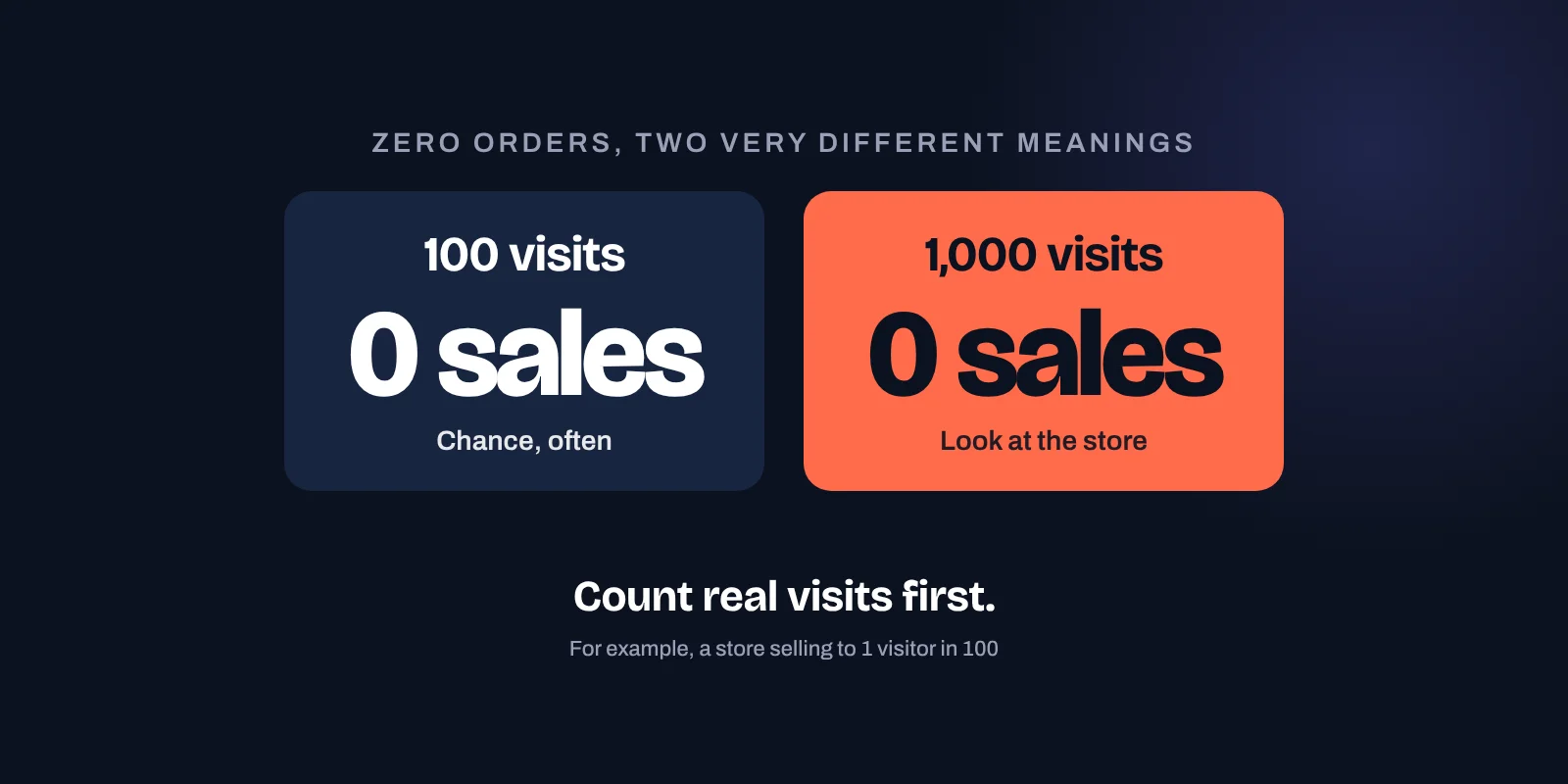
Your orders count is still zero, and you’re deciding whether to blame the product, the store or the ads. Count your real visits first: under a few hundred, zero can still be chance.
Past 1,000 real visits, it isn’t chance any more. That’s when to stop adjusting the ads and look at the store, starting with what a stranger checks before trusting a store they’ve never heard of.
Shopify no sales yet: zero means little before 300 real visits
A real visit is one from someone who could have placed an order. Shopify’s reports already leave out the bots they recognise, so two other kinds of visit are yours to take out.
The first is you. While the store is new, your own checks can be a big share of its visits. Only the ones you open with View store from the admin on a desktop stay out of your reports, so take a rough count of the rest off the total.
The second is visits from countries you don’t ship to, because they can’t become orders. Take those off too, using Sessions by location.
Count from 24 September 2026, or from your launch day if that came later. Shopify changed how it counts visits from 21 to 23 September, so a count that starts earlier mixes two ways of counting.
When zero orders can still be chance
Most visitors leave without buying, even at an established store. On average, 449 established Shopify stores turned 1.9% of their visits into orders in the 90 days to 14 November 2026.
Because most leave, a store that sells will have runs where nobody buys, the way a coin can land tails several times in a row. The question is whether your run of zero is longer than chance explains.
For each number of visits, the table shows the chance of no orders at two rates below that average: one order in every 100 visits, and one in 200.
| Real visits | Selling 1 in 100 | Selling 1 in 200 |
|---|---|---|
| 100 | 37% | 61% |
| 300 | 5% | 22% |
| 1,000 | Under 0.01% | Under 1% |
Take the 300 row. Out of 20 stores that each sell to one visitor in 100, about one would have no orders by then, with nothing wrong with it. That’s the 5% in the table. At one sale in 200 visits, it’s more than one store in five. By 1,000 visits, zero is rare at either rate.
The odds are our own sums, and they treat every visit as a different person. Someone who visits three times is one shopper, not three chances to sell, so read the table as a guide, not as proof.
Under 300 real visits, zero can be chance, so don’t tear up the product, the store or the ads over it. Keep the traffic coming.
Between 300 and 1,000, zero is a warning but not yet a result. Leave the ads as they are and work through the checks in the next two sections, which cost nothing but time. If you change the ads and the store together, you won’t know which change worked.
Past 1,000 real visits, zero is a result: your store is probably selling worse than nine in ten established stores, and more traffic won’t change that. After that many visits with no order, you can be 95% sure it sells to fewer than three visitors in every 1,000. Only the lowest tenth of those established stores sell to so few. Find out where your visits stop before you pay for more.
Under 300 real visits, zero orders can still be chance. Past 1,000, it’s a result.
Where the visits stop shows which page lost them
For a store with no sales, the step where the numbers fall to nothing points to the page to fix. Shopify’s Conversion rate breakdown shows it: how many visits added something to the cart, reached checkout and completed it. Our post on the Shopify conversion rate shows how to read each step.
Two things make that answer meaningless, so rule them out first. A store still in private mode shows visitors a password page that shoppers arriving from your ads can’t get past. And if most of your visits came from one unfamiliar site in Sessions by referrer, or from countries you don’t ship to, the ads are reaching the wrong people. That’s a traffic problem, and no change to the store will fix it.
When nobody adds to the cart, the product page and the offer haven’t convinced anyone. Start with the next section, because a shopper who doubts the store won’t get as far as the price.
When shoppers add to the cart but don’t reach checkout, check whether the cart shows the delivery cost. If it doesn’t, start with that fix in the next section.
When shoppers reach checkout but no order comes through, test your checkout before anything else. If a country you ship to has no shipping rate, shoppers there are told at checkout that shipping isn’t available to their address, and the order stops.
- Start a new checkout for each country you ship to. Enter a real address and check that a shipping rate appears.
- Put payments in test mode. Deactivate your live payment provider and turn on test mode, so you can place a test order without a real charge. Nobody can pay for real until you switch back, so do this when few people are visiting.
- Place an order on your phone as a customer would, paying with the test details. If the order then shows in your admin, a real shopper can get all the way through checkout to payment.
- Switch test mode off and your live provider back on as soon as you’re done.
Done
A CRO audit goes through your store the way a first-time shopper does on a phone, and ranks what’s stopping them.
A stranger is checking whether your store is real
A shopper who taps your ad has never heard of your store. Before they pay, they look for who runs it, what will arrive, the delivery cost, how returns work and what other buyers say. They have reason to be careful. More than 40% of people who told the FTC they’d lost money to a social media scam in 2025 had ordered something they saw in an ad there. A brand-new store has few of those answers on show, so a genuine store can look like the shops they’ve been warned about.
Who runs the store: put your contact details where shoppers look
The stranger’s first question is who’s behind the store. Asked what they check before buying from an online store they don’t know, 47% of US adults said contact information, such as an address or phone number.
Give them a contact page with your business name, an email address you answer and where you send orders from, and link it from your footer. Shopify can generate one as a contact information policy for you. If you trade in Australia, add your ABN, because shoppers there are told that a missing ABN is a sign of a fake shop. These details won’t prove you’re genuine on their own, because scam sites show addresses and ABNs too. Without them, a store fails the first check.
What arrives: show the real product
Next the stranger wants to see the thing they’ll receive. A product page made only of mockups and supplier photos doesn’t show it, and shoppers are warned that a polished, AI-generated shopfront isn’t proof that a business is genuine. Add at least one photo you took of the product itself, in a hand or beside something for scale, so the shopper can see what arrives.
The delivery cost: show shoppers before checkout
The stranger also wants to know the delivery cost, because the total is what shoppers are told to check before they buy. If the product page and cart say nothing about delivery, they can’t work out the total before deciding. Show the delivery cost on the product page and again in the cart, or say what an order has to reach for free shipping.
How returns work: link your policies from every page
Before buying, the stranger wants to know what happens if the order isn’t right: who pays to send it back and how long they have. Shopify can generate a return and refund policy and your terms of service as well. Read what it writes and make it match what you do, because that’s the promise a shopper is buying on.
Shoppers need to find these before they buy, because they’re warned that a store with no terms of service or privacy policy is a sign of a fake shop. At checkout the policies sit behind one “Terms and policies” link, which a shopper reaches only after deciding to buy. Link your return policy, terms of service and privacy policy from your footer menu instead, and put one line on the product page saying how returns work.
What other buyers say: answer what reviews would
Reviews are the check strangers make most: 69% of US adults check customer reviews before buying from a store they don’t know. A new store has none yet. Until it does, put the answers reviews would give on the product page: how the sizing runs, what the material feels like and how long delivery takes. Then ask your first buyers for useful reviews as soon as their orders arrive.
Countdown timers and fake pop-ups: leave them off
Plenty of advice for a new store says to add a countdown timer and a pop-up saying how many people have bought. Leave both off. Shoppers are told to treat countdown timers and pressure to pay as reasons to pause, and while you have no buyers, that pop-up is fake.
Run the stranger test before you buy more visits
Once those fixes are in, run the stranger test. Ask two or three people who don’t know you to buy something on their phones, with no help from you, and note every place they hesitate or ask a question. Each hesitation is something the store still doesn’t answer, so fix it before you pay for the next 1,000 visits.
How to measure the fix: the next 300 to 1,000 real visits
After the fixes, count again from the day you made them, leaving out the same visits as before. Judge nothing before 300 real visits. Between 300 and 1,000, keep the ads as they are and watch the step where your visits stopped before. If more of them reach the cart or checkout, the fix is working before the first order comes in. If zero holds past 1,000, run the stranger test again with someone new.
Checklist
- Real visits counted from 24 September 2026 or your launch day, leaving out your own visits and those from countries you don’t ship to
- The ads left as they are until 1,000 real visits, and no more paid visits after that until you know where they stop
- Checkout tested from your phone in every country you ship to, with live payments back on afterwards
- Contact details, a real product photo, the delivery cost, your return policy and the answers reviews would give, all visible before checkout
- No countdown timers or fake pop-ups, and the stranger test run before you pay for more visits
On a coaching call we count your real visits, read where they stop and go through your store the way a stranger would.

A collective of ecommerce veterans with 15+ years across marketing, development and UX. We audit stores, coach teams and build tools for Shopify merchants.