
You have a new product page layout ready, and you’re not sure shoppers will take to it. An A/B test shows some shoppers the new page and the rest the old one. On a small store, it only picks up a bold change. A small difference looks the same as a lucky week.
You can run the test with an app or with Rollouts, Shopify’s own tool. Either way, the number of orders each version gets decides what the test can tell you. Work that out before you choose a tool, and before you choose what to test.
Why A/B test: to find out before every shopper sees the change
An A/B test earns its place on a change you’re unsure of, where getting it wrong would cost you. A new product page layout is one. A higher free-shipping threshold is another, because it could raise what each order is worth or put off shoppers who were close to the old threshold. Without a test, every shopper meets the change, and a month of sales tells you which way it went.
What a test adds is a fair comparison. Both versions run in the same weeks, so an ad campaign or a slow season lands on both alike. Compare one month with the month before instead, and the campaign or the season can pass for the effect of your change.
A clear fix needs no test. If the add-to-cart button doesn’t work on some phones, fix it, because there’s nothing to learn by leaving half your shoppers with the broken one.
Shopify A/B testing: an app, or Rollouts from the Grow plan
Rollouts, Shopify’s own tool, tests a change to your theme or checkout against the version you have, but only on the Grow plan or higher. On Basic, Rollouts can schedule a change but can’t test it.
A store on Basic pays for a test either way. One route is moving up to Grow, which costs $105 USD a month when you pay monthly. The other is an app from the Shopify App Store. Most bill monthly, and the price rises with your traffic, your orders or the number of tests you run.
Rollouts’ results don’t show revenue, only rates such as conversion rate. A test aimed at what each order is worth, such as a higher free-shipping threshold, needs an app that reports revenue per visitor: each version’s sales divided by its visitors.
Your orders decide what a test can show
A test splits your shoppers evenly, so each version gets about half the orders your store takes while the test runs. A change has to add a lot on top of that half before it stands out from an ordinary good or bad week.
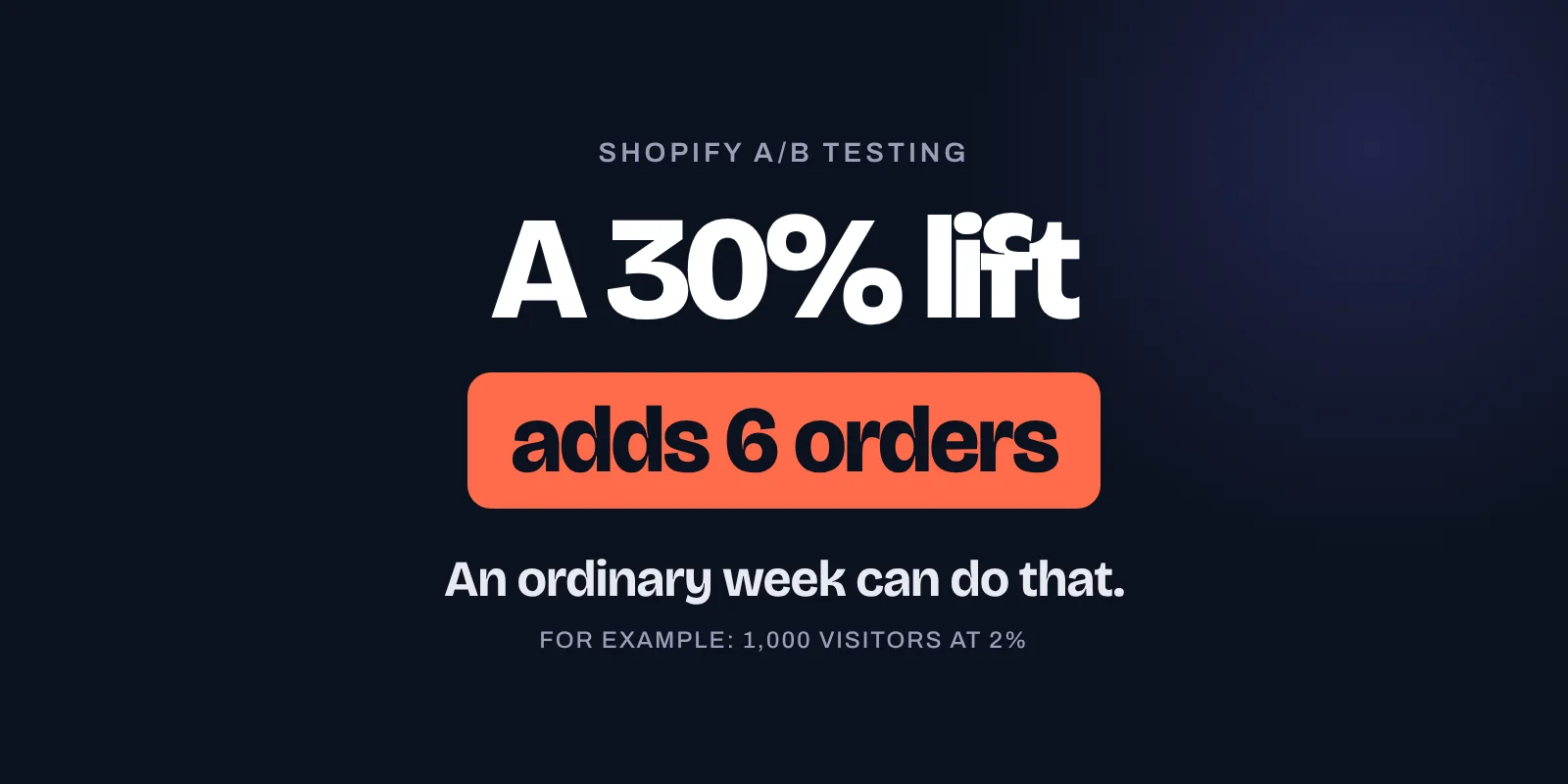
Shopify’s own A/B testing guide says each version needs at least 1,000 visitors, and that the test should run for two weeks. We think that’s too few for most stores, because what decides a test is orders, not visitors. Our arithmetic below uses a 2% conversion rate as an example, not a benchmark. At that rate, Shopify’s minimum comes to 20 orders per version. A 30% lift adds only six of them, and an ordinary week can swing your orders by that much.
| For example | Orders per version | A 10% lift adds | A 30% lift adds |
|---|---|---|---|
| 1,000 visitors at 2% | 20 = 1,000 × 2% | 2 orders | 6 orders |
| 10,000 visitors at 2% | 200 = 10,000 × 2% | 20 orders | 60 orders |
On the second row, 60 extra orders stand out from an ordinary week, but 20 can pass for luck. A standard sample-size calculation gives roughly the orders a test needs to see each lift reliably:
- A 30% lift: about 200 orders per version
- A 10% lift: about 1,600 orders per version
Lifts that big are rare. Most tests don’t win, even at large companies, where roughly one test in ten to one in five improves the thing it was aimed at. A 3% lift in conversion rate counts as a win worth celebrating. On the second row of the table, that 3% is six orders, which no test of that size can pick out.
Here’s where we draw the line, with a four-week test as the example. A store needs about 400 orders a month before a test can see a 30% lift. To see a 10% lift, it needs about 3,200. Below 400 a month, a four-week test can’t see a lift as big as 30%, and your time is better spent elsewhere.
On a small store, a test can only see a big lift, and big lifts are rare.
A small store: test bold changes where shoppers decide to buy
By a small store we mean one with about 400 to 3,200 orders a month. A test there can see a 30% lift, but not a 10% one. No change is sure to add 30%, but a change most shoppers barely notice has little chance of it, so test only bold changes. A bold change is big enough that shoppers can’t miss it, and it sits where shoppers decide to buy:
- A new product page layout that puts the answer to your shoppers’ most common question beside the price. For many stores that’s sizing or shipping time.
- Shipping cost shown on the product page, rather than first in the cart. Our post on Shopify’s abandoned cart email covers what happens when shoppers meet it late.
- The offer, such as a bundle or a higher free-shipping threshold. An offer is aimed at what each order is worth, so you need an app that reports revenue per visitor. Revenue per visitor swings more than conversion rate, because order values vary. That means an offer test needs at least as many orders as a layout test. Our post on bundle pricing shows how to set a bundle’s discount before you test it.
A new button colour is small by comparison. It might help, but on a small store no test will tell you, so make that kind of change on judgement or leave it.
A bold change often combines several edits, as a whole new layout does. The test then tells you which version sold more, not which edit made the difference. That’s a fair trade, because a clear answer about a big change beats no answer about a small one.
On a coaching call we look at your store and its sales with you, and pick a change a test can measure.
Under 400 orders a month: fix what’s broken, then change and compare
A store with fewer than 400 orders a month gets more from fixing and changing than from testing. Start with the clear problems, the kind that need no test, like the broken button in the first section. A size chart link that opens an empty pop-up is another. Each fix wins back shoppers the problem was turning away.
Then make bold changes without a test. Keep a copy of your current theme so you can switch back. Compare the same number of whole weeks before and after in Shopify’s reports, using the change’s metric, such as conversion rate.
Treat what you find as weaker evidence than a test. A sale or the season can move your numbers between the two periods, so note anything else that changed in those weeks before you credit the change.
Reading a result: choose the metric and end date before you start
Decide how long to run an A/B test before it starts, and pick one metric: the one the change is aimed at. Your orders set the end date. Run whole weeks, so both versions see every day of the week. Then count how many it takes to reach about 200 orders per version, the count a 30% lift needs. Take a store with 400 orders a month, for example:
- The store takes about 100 orders a week, so each version gets about 50.
- Reaching about 200 orders per version takes four weeks.
- Six or eight weeks give a firmer answer.
To work out the weeks for your own store, the A/B test calculator takes your traffic and conversion rate, and checks the result when the test ends.
Leave the test alone until that date. Early on, a handful of orders can put either version well ahead, and the lead often fades as more come in. Stopping on an early lead turns luck into a result. Changing either version partway through mixes two tests into one.
A loss is an answer too. If the new layout sells less, only half your shoppers met it, and only until the end date. Without the test, every shopper would have met it.
Measuring the result: the same metric, once the better version is live
Once the better version is live for every shopper, check the metric you tested in each of the weeks that follow. If it stays near the level the test showed, the change is holding up. If it drifts back, the test may have caught a lucky stretch. Our post on Shopify’s conversion rate shows how to read each step of Shopify’s funnel report.
Checklist
- Your store takes at least 400 orders a month before you test at all
- You test a bold change where shoppers decide to buy: the product page or the offer
- Your tool reports the change’s metric: conversion rate for more buyers, revenue per visitor for order value
- You set the metric and an end date that reaches about 200 orders per version, and change neither version until then
- Under 400 orders a month, you fix clear problems first, then make changes without a test and compare whole weeks before and after
A CRO audit follows a shopper through your product page, cart and checkout, and ranks the changes worth making first.

A collective of ecommerce veterans with 15+ years across marketing, development and UX. We audit stores, coach teams and build tools for Shopify merchants.